
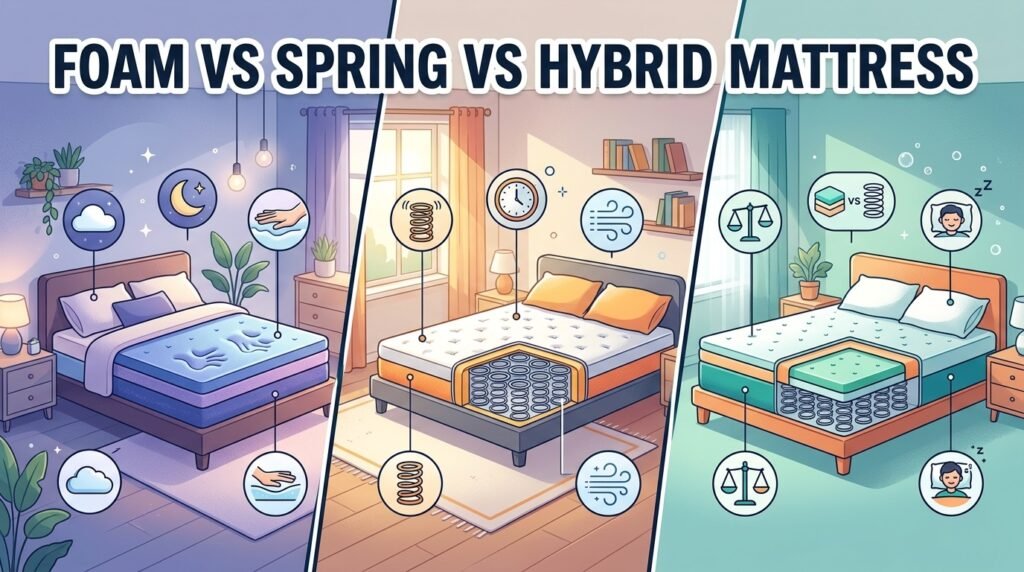
Are you waking up with persistent lower back stiffness or feeling exhausted even after eight hours in bed? Finding the best mattress in Pakistan comes down to understanding how different mattress constructions interact with your body weight, sleeping posture, and local weather conditions.
Also Read: Which Mattress is Best For Hot Weather in Pakistan?
High humidity during monsoon months, heavy summer heatwaves, and traditional solid wooden bed bases all influence how a mattress performs over time. Selecting between high-density foam, independent pocket springs, and multi-layer hybrid designs requires balancing personal comfort with long-term durability.
Understanding High-Density Foam Mattresses
Foam mattresses remain a dominant choice across Pakistani households due to their solid support and consistent surface feel. High-recovery polyurethane foam and pressure-relieving memory foam contour closely to the natural curve of your spine, distributing weight evenly.
Core Benefits of Pure Foam
- Uniform Back Support: Polyurethane foam provides continuous spinal alignment without pressure gaps.
- Zero Motion Transfer: Memory foam layers absorb movement instantly, preventing partner disturbance during sleep.
- Firmness Options: Ranging from orthopedic firm options to plush memory foam tops, foam accommodates varied medical recommendations.
Foam mattresses perform exceptionally well on traditional flat slatted frames or solid plywood bed surfaces common in local bedrooms. However, traditional high-density foam can retain ambient body heat. Buyers in warmer regions like Sindh or South Punjab should look for open-cell structures or gel-infused cooling foam layers to maintain a balanced sleep temperature throughout hot summer nights.
Evaluating Pocket Spring Mattress Systems
Spring mattresses utilize engineered steel coils wrapped in individual fabric pockets or interconnected in an open matrix to deliver responsive, bouncy support.
Key Distinction: Pocket spring systems isolate individual body pressure points, while traditional open spring units offer overall surface bounce.
Advantages of Spring Construction
- Exceptional Ventilation: Natural air passage through spring cavities keeps the mattress cooler during humid summer weather.
- Targeted Contour: Pocket springs compress independently, supporting heavier areas like hips and shoulders while maintaining lumbar posture.
- Edge Stability: Reinforced perimeter springs make getting in and out of bed easier for older adults.
Pocket spring mattresses suit individuals who change sleeping positions frequently throughout the night or those who prefer a buoyant, traditional feel over a deep sinking sensation.
The Hybrid Advantage: Combining Foam and Pocket Springs
Hybrid mattresses combine the pressure relief of memory foam or gel layers with the structural strength of an underlying pocket spring core.
Why Choose a Hybrid?
- Balanced Temperature: The open pocket spring base promotes air circulation, offsetting the heat-retention tendency of top foam layers.
- Dual-Action Support: Memory foam cushions joints at the surface, while responsive pocket springs prevent improper spinal dipping underneath.
- Extended Service Life: Combining resilient steel pocket coils with high-density foam reduces surface sagging over years of daily use.
A hybrid model serves as an effective compromise for couples who hold different comfort preferences or require a mix of cooling air movement and cushioned pressure relief.
Comparison: Foam vs. Spring vs. Hybrid
| Feature | High-Density Foam | Pocket Spring | Hybrid |
| Best For | Back pain relief, zero motion transfer | Hot sleepers, traditional bounce | Balanced contour, cooling airflow |
| Firmness Range | Medium-soft to extra firm | Medium to firm | Medium to medium-firm |
| Heat Dissipation | Moderate (Requires gel/cool tech) | High (Natural airflow) | High (Breathable hybrid core) |
| Durability | High (High-density foam cores) | Moderate to High | High |
| Bed Base Compatibility | Solid plywood, flat slats | Slatted frames, box springs | Box springs, solid platform beds |
Key Factors When Buying a Mattress in Pakistan
Choosing the ideal surface requires evaluating specific regional and physical needs before making a purchasing decision.
1. Room Climate and Heat Management
High summer temperatures require breathable materials. If your bedroom lacks continuous climate control, prioritize pocket spring units or high-density foam incorporating cooling gel infusion to avoid heat buildup.
2. Sleeping Position and Body Weight
- Side Sleepers: Benefit from hybrid or memory foam surfaces that cushion shoulders and hips.
- Back and Stomach Sleepers: Require firmer high-density foam or pocket spring bases to prevent lower back dipping.
- Heavier Individuals: Need thick pocket spring or hybrid options with higher coil counts for lasting structural support.
3. Mattress Sizing Standards
Local bed frames vary in dimensions. Standard sizing typically includes:
- King Size: 78 × 72 inches
- Queen Size (Option 1): 78 × 60 inches
- Queen Size (Option 2): 78 × 66 inches
- Single Size: 78 × 42 inches
Always measure your bed frame inner dimensions accurately before selecting a mattress size.
4. Trusted Brand Reliability
Reliable manufacturers offer clear warranty coverage and consistent material density. Well-established names like Diamond Supreme Foam provide specialized product lines, including high-recovery polyurethane foam, specialized orthopedic lines, and responsive pocket spring designs tailored for local conditions.
Quick Decision Guide for Quick Selection
- Choose High-Density Foam if you suffer from joint pain, share a bed with a restless partner, or prefer a firm, supportive surface.
- Choose Pocket Spring if you sleep hot, enjoy a buoyant feel, or prefer firm edge support for easier mobility.
- Choose a Hybrid if you want the soft contouring of memory foam alongside active airflow and responsive pocket spring support.
Frequently Asked Questions
Which mattress type is best for lower back pain?
Orthopedic high-density foam mattresses or zoned pocket spring systems generally offer the best spine alignment for back pain relief. They prevent your midsection from sinking too deep, keeping your back in a neutral alignment throughout the night.
How long does a quality mattress last in local weather conditions?
A well-constructed mattress typically lasts between 7 and 10 years. Rotating the mattress end-to-end every three to six months helps prevent uneven body impressions and extends core lifespan.
Is a spring mattress suitable for hot summer weather?
Yes, pocket spring mattresses allow air to circulate freely through the inner steel coil chamber, dissipating body heat much faster than solid foam cores.
What is the difference between a memory foam and a hybrid mattress?
A memory foam mattress consists entirely of foam layers that conform closely to the body. A hybrid mattress pairs top memory foam layers with an underlying pocket spring base to blend contouring comfort with cooling airflow and bounce.
Can I place a new mattress on a traditional solid bed base?
High-density foam and hybrid mattresses perform exceptionally well on solid plywood bases. Pocket spring mattresses require a flat, non-sagging surface or box spring to prevent spring damage.